Portable Structure | Faina Feigin Landau
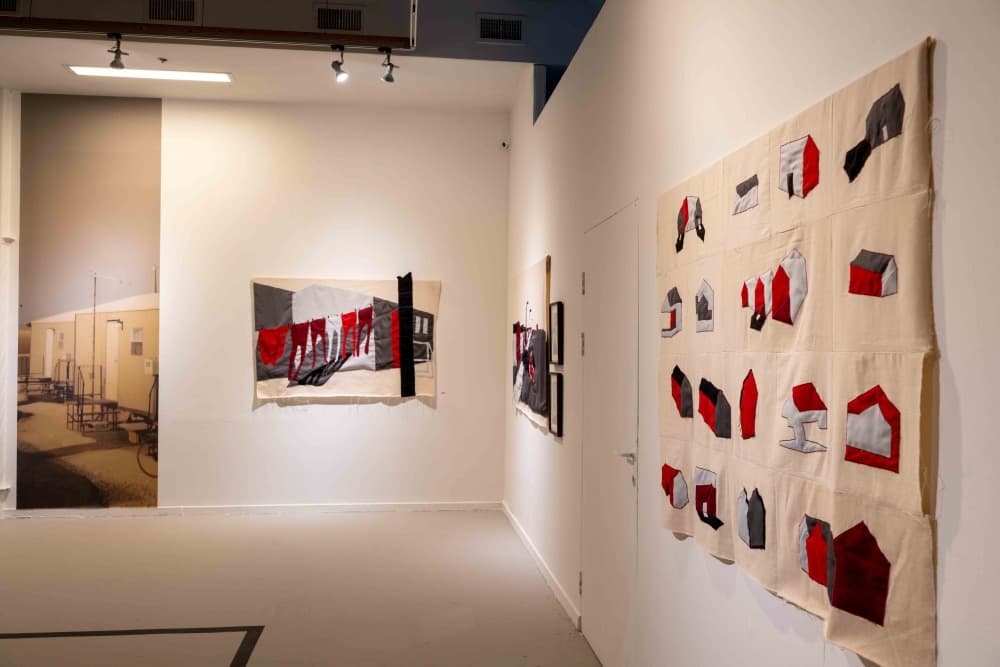
The exhibition presents the life story and memories of artist Faina Feigin Landau, who immigrated from the former Soviet Union and lived in a caravan site in Haifa. In her work, she weaves life stories and memories through various artistic mediums, bringing to consciousness a forgotten era and neighborhood.
The exhibition presents the life story and memories of artist Faina Feigin Landau, who immigrated from the former Soviet Union and lived in a caravan site in Haifa. In her work, she weaves life stories and memories through various artistic mediums, bringing to consciousness a forgotten era and neighborhood.
The 1990s were intense years of massive immigration from the former Soviet Union and Ethiopia – immigration that changed Israeli reality. As a quick solution to the housing shortage that emerged in the country, caravan sites were established as temporary residential neighborhoods for absorbing the immigrants. Nearly 30,000 caravans were placed in many locations across the country, including in Haifa, and turned into immigrant neighborhoods. These neighborhoods and the new lives built within them, sometimes in difficult circumstances, are an important story in the history of Israel and Haifa.
Artist Faina Feigin Landau immigrated at the age of 3 with her family from the former USSR and lived in the Neve Carmel caravan site on the southern outskirts of Haifa, which housed around 1,000 caravans. On the site of the caravan park, the modern, generic, and bourgeois Neot Peres neighborhood was established a few years ago. Neve Carmel was completely erased from the land, and no trace remains in the public consciousness. The neighborhood is not an exception – most of the public today neither remembers nor is familiar with these housing sites – a product of "migration architecture": a temporary home in an unfamiliar and unsafe space.
The temporary home was not erased from Landau's memory, nor from the memories of other people who lived in other caravan sites across the country with whom she met and spoke. Landau weaves their stories and memories, as well as her childhood stories and personal memories, into the exhibition "Mobile Structure" through various artistic media – quilt works, animation, and paintings – into a story of a forgotten era and a neighborhood erased from the landscape with no memory of it.
Institutional archives hold significant weight in constructing the identity of the individual and society. In the collective memory, it is easy to erase pieces of history by concealing or blurring them from the archive as a means of shaping consciousness. There will never be a collection that expresses all facets of a city, community, or population. From this understanding, initiatives have emerged in recent years seeking to fill the gaps in institutional archives and even attempt to rewrite collective memory. This is also the aim of Faina Feigin Landau's work, created through the "Place Art Incubator" at the Haifa Museums: the establishment of an independent community archive based on sharing photos and memories of private individuals. All materials have been uploaded to a dedicated website, which continues to develop dynamically, exposing a time and place impressed upon the residents of the caravan sites but not necessarily in the general consciousness.
Yifat Ashkenazi
Curator of the Haifa City Museum
Oz Zloof
Curator of the Place Art Incubator


