Exhibition: Mammals in the Depths - The Wonderful World of Marine Mammals
The exhibition presents the world of marine mammals of the Mediterranean Sea and the Gulf of Eilat. Its uniqueness lies in the connection between man and nature and the invention of various marine mammal exhibits.
The exhibition presents the world of marine mammals of the Mediterranean Sea and the Gulf of Eilat. Its uniqueness lies in the connection between man and nature and the invention of various marine mammal exhibits.
The Wonderful World of Marine Mammals in the Mediterranean Sea and the Gulf of Eilat
An exhibition in collaboration with the Marine Mammal Research, Information, and Assistance Center in Israel (Machmal'i)
Racah Institute for Maritime Studies, University of Haifa
In memory of Tal (Talsky) Eylon, late
Exhibition opening: Friday, 04.07.25, 10:00
(Closing: Saturday, 26.06.27)
Curator: Adi Shlah
On the opening day of the exhibition, the museum will be open to the public free of charge, with two guided tours of the exhibition at 11:00 and 12:00 by the museum curator, in collaboration with members of the Machmal'i association.
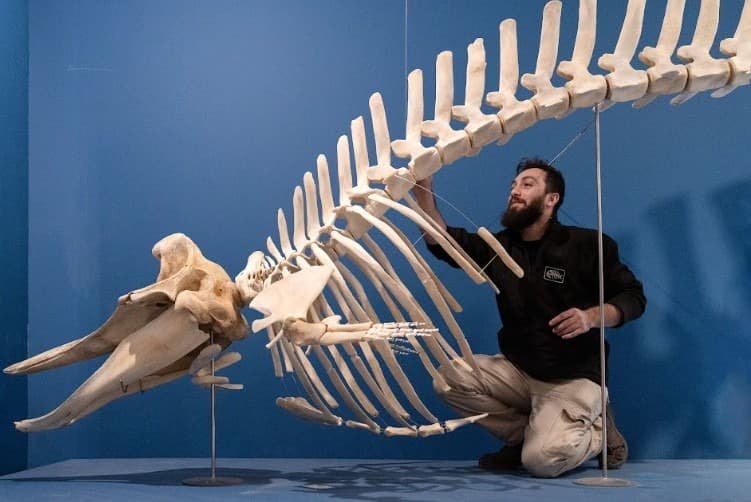
Skeleton of a common dolphin | Photo: Jenny Katzner
Since the dawn of history, marine mammals have captured the curiosity of seafarers, ignited their imagination, and also evoked their fears. Whales, dolphins, and sea monsters appear in mythological stories across all cultures that lived along the shores of seas and oceans, finding in the sea a source of life. Even today, in an era where science and technology can explain and document many phenomena that were once hidden from view, marine mammals continue to enchant humanity. They draw people to the sea who seek to explore, with curiosity and passion, their ways of life.
The exhibition before you is the product of this special relationship between humans and nature. It brings to the museum for the first time exhibits that testify to the very diverse presence of marine mammals in our area. The deep-sea mammals of the Mediterranean Sea and the Gulf of Eilat, which is an extension of the Indian Ocean, include various species of cetaceans (whales and dolphins) and one seal species. The unique findings that attest to their existence are brought to us by a special group, the Machmal'i association, whose members dedicate their best efforts to researching the world of marine mammals and helping to protect their living environment.
Members of Machmal'i, most of whom are volunteers, document marine mammals through surveys, work on developing practical solutions to threats that endanger them, and conduct educational activities to raise public awareness on the subject. They also collect cetaceans that have died and washed ashore – a phenomenon known in Hebrew as "hachafa" (in English: stranding or beaching). Fresh specimens are transferred for post-mortem examination to determine the reasons for their death and various samples are taken from them, while non-fresh specimens are buried for the decomposition of soft tissues and preservation of bones. In this way, over three decades, a large and impressive comparative collection of skeletons or skeletal parts, mainly skulls, has been built – a process that allows for close study of them.
This is the most comprehensive display in Israel to date dedicated to marine mammals. It includes skeletons, skulls, and bones of 11 different species of cetaceans out of the 18 species whose presence has been documented in the waters of Israel. Since the sea never ceases to surprise us, it is likely that additional items will join the collection of this exhibition in the future.
Adi Shlah
Curator of the National Maritime Museum


